
How the Gospel of Grievance Gave Rise to a Post-Truth Faith
“The surest way to corrupt a youth is to instruct him to hold in higher esteem those who think alike than those who think differently.”
— Friedrich Nietzsche
“Ignorance more frequently begets confidence than does knowledge.”
— Charles Darwin
In February 2020, during the State of the Union address, the president of the United States awarded Rush Limbaugh—a crass vulgarian—the nation’s highest civilian honor: the Presidential Medal of Freedom.
In doing so, he elevated the AM-radio provocateur to the ranks of those whose work and spirit he had made a career of publicly disparaging—the very voices of conscience, reason, and imagination he taught his audience to distrust and dismiss.
Rosa Parks, Martin Luther King Jr., John Lewis, Cesar Chavez, Thurgood Marshall, and Nelson Mandela; Stephen Hawking, Albert Einstein, Jonas Salk, Rachel Carson, and Katherine Johnson; Harvey Milk, Maya Angelou, Tennessee Williams, Georgia O’Keeffe, Bob Dylan, and Bruce Springsteen; Muhammad Ali, Jesse Owens, and Jackie Robinson.
And now, Rush Limbaugh.
Ecce homo.1
The honor had once symbolized moral courage, conscience, struggle, and sacrifice. Now its essence had been inverted.
The reality-television president—ever resentful of anyone who might contradict, reprimand, or upstage him—had, in a single gesture, reduced the Medal of Freedom to a reprobate’s prop in a postmodern theater of trolls.
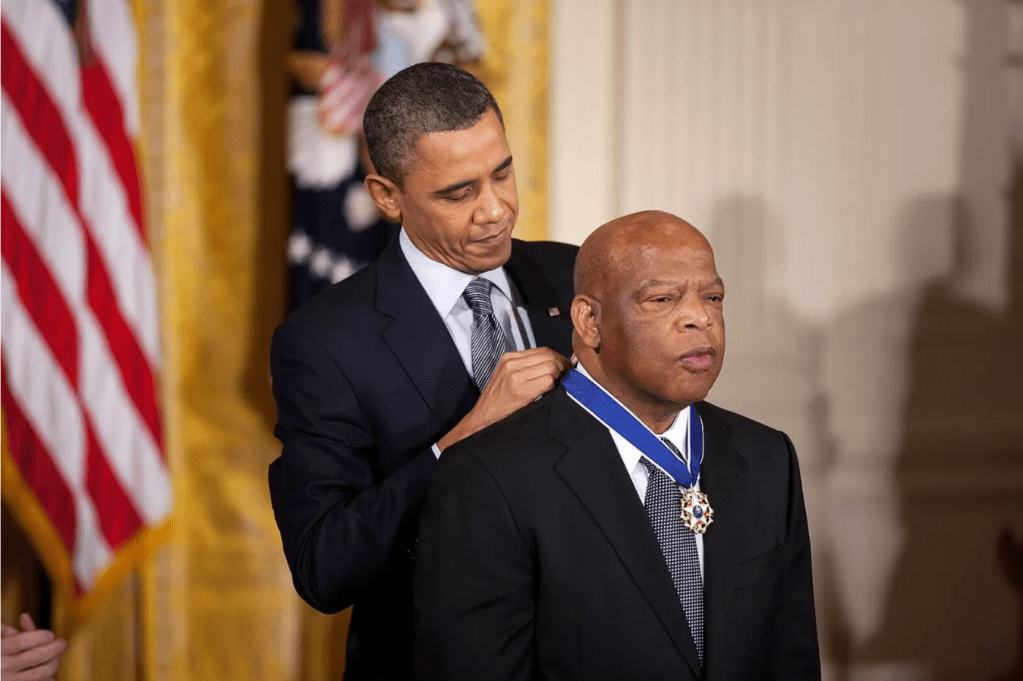
Beneath the chandeliers, before a divided Congress and broadcast to an audience of millions, the First Lady draped the medal over the shoulders of a syndicated, anti-intellectual demagogue who had profited handsomely from the post–Fairness Doctrine media landscape—and built a self-satisfied, ditto-headed cult of bigotry, misogyny, racism, and resentment.
Now battling lung cancer, the college dropout—who had shown little interest in either science or the humanities—had spent the healthier years of his adult life puffing cigars while denying the well-established link between smoking and disease.
He spent his most productive years gleefully ridiculing the victims of AIDS in his infamous “AIDS Update,” during which he played Dionne Warwick’s “I’ll Never Love This Way Again.” His public contribution was to tell his listeners that it was the victims’ fault that they had contracted “the Rock Hudson disease.”
His civic contribution was to mock the dying.
This is the man the president elevated as an ideal model for our boys—the man who willfully misunderstood and misrepresented the struggles of women.
This is the man who, in one of his more poetic moments, mocked moral intelligence and coined the epithet feminazi.
I refuse to forgive him. My metaphysics do not demand it. He narrowed my daughter’s world.
And this is the man who, in his infinite compassion and wisdom, told women—our mothers, our sisters, our daughters—that if taxpayers were to foot their bill for birth control and protection, they should post sex videos “so we can all watch” our tax dollars hard at work.
Yes. This is the man.
Over this man’s shoulders the First Lady draped the Presidential Medal of Freedom before she turned toward the flashing cameras—and smiled.
And this is the man who—years before the career-crushing anti-DEI campaigns and civil-rights-crippling crusades of the present regime—was lamenting “reverse racism,” resurrecting that old anti–civil rights phrase even as he repeatedly aired a parody song titled “Barack the Magic Negro.”
This was the same man who, in order to disparage public assistance programs and justify tax breaks for the trickle-down lifestyles of the rich and famous, amplified and normalized Reagan’s racist trope of the “welfare queen”—a stereotype born not of data but of resentment, invented precisely when Black women began to receive the aid once reserved for struggling whites.

Yes, it was this recipient of the nation’s highest civilian honor who, in 2008, first tilted his microphone toward the far-right chatter of the “birther” conspiracy and amplified it through 2009. He insisted that Barack Obama “had yet to prove his citizenship.” By 2011, Trump had discovered that the same racist lie could turn microphones—and television cameras—his way.
So much now came to rest on this man’s epistemology of aesthetics—on his laurels of the rich and famous, the beautiful and blessed, the golden and spit-shined—where it followed that knowledge and notoriety nearly rhyme.
And by the end of Obama’s second term, nearly a fifth of Americans doubted his legitimacy as president. The seedbed of suspicion from which January 6th would grow had already been sown; the soil of reason itself was beginning to erode—into a kind of mental Dust Bowl.
A crisis of legitimacy was well underway, and the republic’s institutions were beginning to crack under the strain.
America was becoming a post-truth society.
And now, as if to complete the vicious cycle, Trump—re-elected on a foundation of conspiracies and hate—has posthumously awarded Limbaugh’s acolyte, Charlie Kirk, the same Presidential Medal of Freedom.
Before the ceremony—after the assassination—the president ordered the nation’s flags lowered to half-staff, forcing those upon whom Kirk had so often punched down to look up in horror.
Many feared to speak out.
The president honored him on October 14, 2025—on the provocateur’s thirty-second birthday—standing beside his widow on the newly paved concrete slab that was once Jacqueline Kennedy’s Rose Garden.
Reading from his teleprompter, he denounced “radical left violence,” baselessly insinuating that his political opposition was collectively guilty of murdering the man—intent on writing, controlling, and twisting the narrative into submission, staging his own small, remastered pageant of will over reason—a little televised Triumph of the Will for the post-truth age.
“He who controls the past controls the future. He who controls the present controls the past.”
— George Orwell, 1984
Let us not forget that Kirk was also a master of media, and a superb editor of scripts. He did, after all, bus enthusiastic patriots to the Capitol on January 6, only to take to frantic revision in the aftermath, working like a saintly medic to revive Trump’s wounded image in the ash cloud that followed.
By the time Kirk had reshaped and repackaged the story—helped by Bannon and other apostles of the new right media—the wounded man had, verily, resurrected and descended from the clouds: a divine, if imperfect, instrument of the Divine Will.
All that Protestant work-ethic and white-out worked a miracle.
A triumph of will, indeed.
Nor should we miss that Kirk’s own narrative is now being drowned in gallons of liquid white-out, as conflict entrepreneurs labor to remake his image into that of a martyr.
The surest way to detect the cognitive dissonance in those quarters is simply to quote the man. Just be prepared for the blow-up.
Context rarely helps his case.
The blow-up itself is a kind of good news—it implies a latent moral compass, a buried conscience struggling to breathe. It signals something more than a blush in an age without shame.
But the glowing image—the one of the white knight in shining armor—has its uses. Political uses. Visceral uses.
And the revisionists do not intend to squander it.
The best time to hook a client on your brand of cigarette is before his mind has matured—before he’s equipped to recognize the link between the smoke, the mirrors, and the disease.
The branding campaigns have begun in earnest. The ash is already falling like an angelic snow that settles over the blasted heath.
I’ve already watched vulnerable young boys—the same polite kids, often adrift without steady mentors and drawn to hero worship—begin to echo the algorithmic rhetoric surrounding his mythic message.
Had Kirk lived to wiser age, he might well have changed his mind on many things. People grow. But one thing is certain: his voice is no longer his own. He’s been converted into a prop in the messianic theater of profit and trolls.

None of this is to deny that Kirk’s death was horrific. It is to suggest, rather, that the assassination was even more tragic than we have yet understood, and that its reverberations will be generational.
It’s being used to radicalize young men. It’s being used to recruit an army of the Lord. It will be used to exact arbitrary power. The mission’s as dark as the Crusader’s ink that crosses Pete Hegseth’s chest.
Many of these theocratic patriots have already been armed by the state. They patrol our streets wearing masks, convinced they are doing the dirty work of the good knight—fighting corruption, purging evil, upholding the law.
Like Limbaugh before him, Kirk dropped out of college to follow the path of the primrose provocateur. And though he was not quite the same breed of vulgarian as his hero—his brand being more earthy, wholesome, and pseudo-intellectual—his Turning Point USA managed to do something The Rush Limbaugh Show never did: it bound together the two great threads that Reagan wove into the fabric of modern conservatism.
The organization is openly Christian Nationalist—paternalistic and racially hierarchical—fusing the hyperbolic Archie-Bunkerism of Limbaugh’s audience with the martyr metaphysics, divine-command ethics, and medieval epistemology that sustain the anxious, ‘persecuted’ faith of contemporary evangelicalism.
To understand how the epistemic soil was prepared for this postmodern, post-truth moment, we have to look back to how the party of Lincoln learned to preach what we might call a neolibrian gospel—the gospel of profit, providence, and omniscient markets—in the language of the Lord.
We have to recognize how it cast doubt on science—the Lord’s usurper—particularly when its utilitarian authority was not needed to sanctify Reagan’s so-called Star Wars defense program or the bomb, or when it dared to remind us that it is our duly elected primate who rests a heavy-ringed finger on that existential button.
Amen.
🌈 If you missed Field Note 3¾ — The Rainbow Connection: Don’t Believe Everything You Think, click here.
🍭 If you missed Field Note 3.2, “All The King’s Candy,” click here.
🎧 Prefer to listen to this piece? Click here.
- Ecce homo — “Behold the man.” Pilate’s words to the crowd as he presented Christ in mockery. ↩︎
 No Shortcuts to Now
Leave a comment