From Chapter 2, “The Soul’s Ascent”
“We should take long, wandering walks outdoors, so the mind may be nourished and refreshed by open air and deep breathing.”
— Seneca (b. Cordoba, Spain, 4 BCE)
Breath is spirit. All living things breathe, or re-spire. The ribs are a bellows, which fans and feeds life’s flames, and warms flesh that, for a moment, remains supple. And when we die? We release a final breath, and ex-pire.
It’s an old Latin metaphor, the spirit, which lies hidden in our linguistic inheritance. And along with the Latin word spiritus, we’ve inherited the Greek word psyche, which also relates to wind and breath. Psyche means soul. Soul’s that certain invisible something which animates the body, and which lifts it, like the wind a leaf.
It just so happens that the Greeks represented a departed soul with a butterfly.
They called the chrysalis nekydallon, which means “shell of the dead.” They thought the human body to be like the chrysalis, from which at death the soul escapes. Nor are they alone in making the analogy. The Egyptians wrapped their mummies in layers of linen, creating forms that are often compared to cocoons. And Christians still symbolize resurrection with butterflies.
But there’s a little lower link we might make. Across countless cultures, both butterflies and volcanoes represent the cycle of death and rebirth.
California, part of the Pacific Ring of Fire, once belonged to Mexico — which had once belonged to the Aztec Empire. The Spanish conquered the Aztecs in the 16th Century, and effectively buried the ancient culture under hard rock and powdery ash.
Yet, with maize-like roots, Mexican culture reached deep and absorbed much of what came before. And so have we.
The Aztec spirit lives on in English — in our foods (chocolate, chipotle, tamale, guacamole), in our drinks (tequila, mescal, atole), in animals (coyote, quetzal, axolotl), in everyday things (chicle), and even in the name of a nation: Mexico. Others, like Guatemala and Nicaragua, reflect indigenous or Nahuatl-influenced roots.
Every time we speak one of these words, an ancient indigenous spirit is let loose to circle on the wind.
Speech is a kind of resurrection.
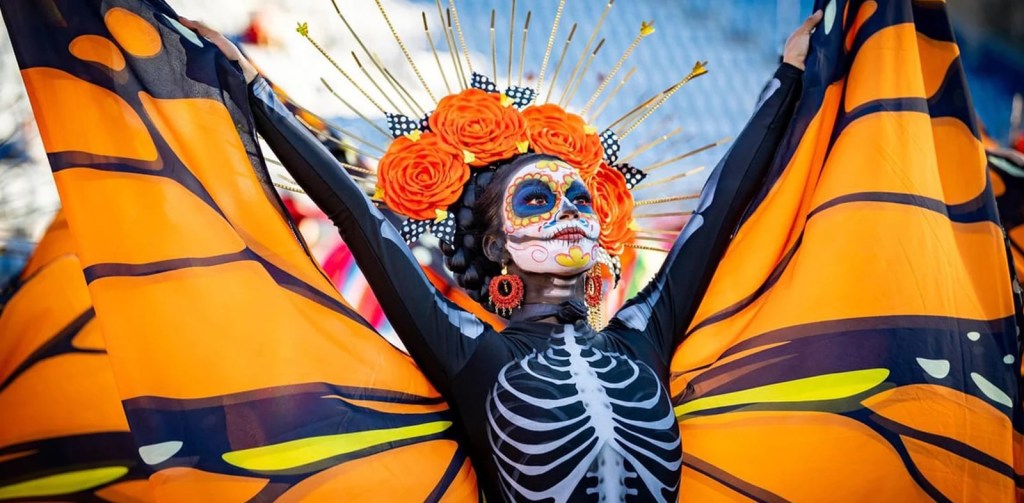
Image credit: Ian Georgeson, via Pipiripau. Día de los Muertos and the Monarch Butterflies
Every year, on the last calendar day of October, brittle leaves are blown from fall trees, and American children carve pumpkins and dress up for Halloween — and Mexicans begin to celebrate The Day of the Dead.
Mexican culture absorbed — and was layered over — the Aztec holiday, just as Christianity absorbed Pagan rites in Europe.
Neither the Easter Bunny, nor Easter eggs, nor Santa Claus, nor the Christamas tree appears in the Bible.
No culture ever really dies, but its soul transmigrates.
Well, on The Day of the Dead, in The New World, butterfly costumes flutter about, colored rich with Aztec symbolism. As to the ancient Greeks, so to the ancient Aztecs: The butterfly symbolized cycle and transformation. Thus the Aztecs decorated the chest of their fire god Xiuhtecuhtli with a turquoise butterfly.
Xiuhtecuhtli’s a dynamic god: the god of day, time, and transformation. He’s also a volcano god — I can almost hear our pint-sized priest’s primeval call now, echoing through the flames: “Vah-ca-no! Yeah! Pwikhh! Pwikhh! Boom!” — this Aztec heart of the mountain, this divine smith of creation, sends up quakes of renewal and reshapes the face of the earth. From a curious mix of ash, earth, fire, and water, new life emerges — and in turquoise, his sacred color, the god takes form.
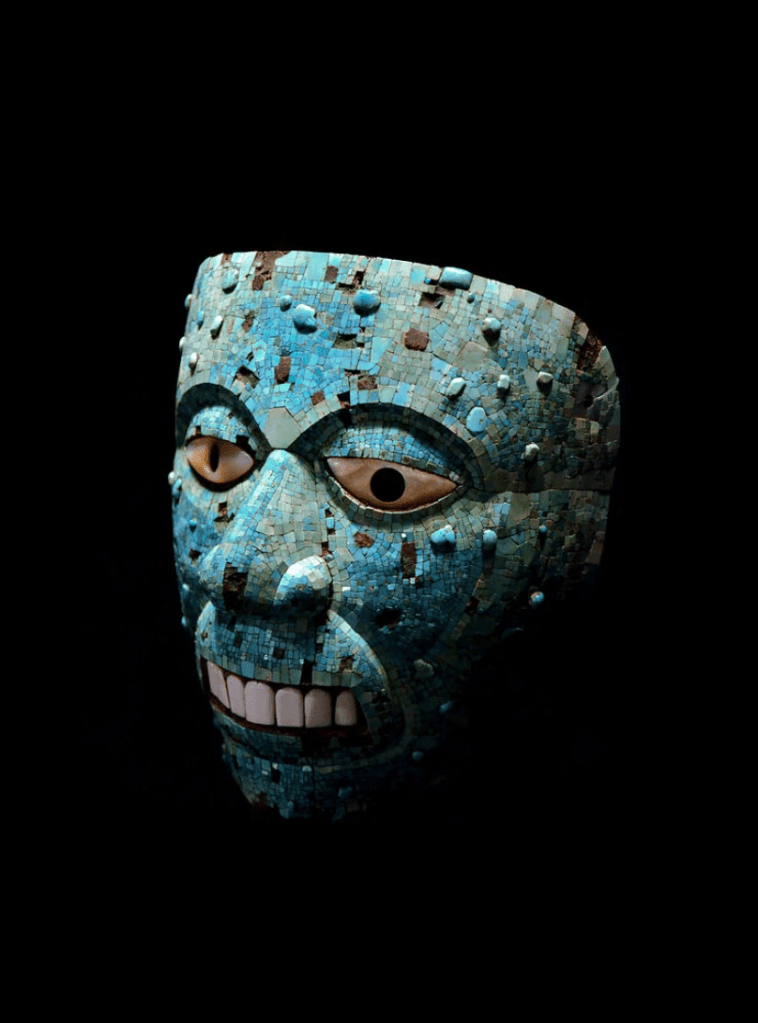
Mask of Xiuhtecuhtli, Aztec god of fire and renewal — turquoise, cedarwood, shell, and flaking gold leaf — elements of earth transformed into spirit. (British Museum)
Our own word turquoise transmigrated to us from the French; and the French first got turquoise from Persia through Turkey. In fact, Turquoise means “Turkish.” But the Aztecs called it chalchihuitl. Literally translated, it means “heart of the earth.” And their fertility goddess Chalchiuhtlicue derives her name from this earthen word.
Chalchiuhtlicue’s the goddess of water, harvests, and childbirth. The fertile water of her womb flows down mountains. She’s the wife of the volcano god of fire, Xiuhtecuhtli. Theirs is a marriage of yin and yang, the archetypal unity of opposites, bound in a boundless, nay, borderless circle, whose eternal center is everywhere.
All happy families are alike. And like all happily married men, Aztec men also felt the need to stave off angry female star deities. They kept track of sacred anniversaries, not in order to preserve domestic bliss, but in order to prevent the death of the Sun.
In preventing the death of the Sun, they solved the age-old problem of calendrical drift. To do this, every fifty-second year — not long after our own Western calendars turn from October to November — they performed the New Fire Ceremony, and reset their sacred calendar.
Priests hiked to the top of a volcano, to a Sun temple, near present day Mexico City. On this holy day, they brought with them a sacrificial prisoner. As the Sun sank, angry stars began to appear in the darkening sky. The people below feared an apocalypse, the end of time, but they kept their faith: the world could be saved with sacrificial blood, and be born again.
In the city below, pregnant women — vessels of the sacred cycle — had their faces painted water-blue, possibly for Chalchiuhtlicue’s protection, and were locked into granaries, lest they transform into monsters. Children were kept awake, so they’d not turn into mice. Not a creature was stirring. Every fire was extinguished. Old hearthstones were cast out. In anticipation of the New Fire, people climbed onto rooftops to look toward the volcano — watching for a sign: Will the world be reborn?
As this ancient night grows deeper, the stars begin to align just so. The next 18,980 days depend on the success of this sacrifice. In the temple now above us, elaborately dressed priests lay a log on the prisoner’s chest, behind whose heavily heaving ribs pounds a living heart, filled with hot blood.
Just below his rib-line, the priests place the sacred blade; and in an instant, they slice open his body, sever his diaphragm, reach through, cut his heart free, and pull it out, lightning quick. It still beats.
This sacred feat accomplished, they hollow out his abdomen, and lay his soft, warm entrails aside in specially prepared dishes. Presently, they lay the sacred log within the hollowed cavern of the cadaver, and light it aflame. It burns bright as a butterfly’s golden wings, a symbol of life after death.
Below, the people receive glad tidings: The Sun will rise again. The world will be reborn. We hear the buzz of celebration. The granaries are opened, and our blue-faced mothers to-be come out. Children run and play.
All put on their best clothes, and eat honey cakes. Adults drink pulque beer. Calendars are set to zero.
This may be no leap-year solution; but this world, like ours, depends on the accurate measurement of time; for a little time is all we have, and each other, and hope for the next generation, and a new dawn.
So the wheel of time turned. And perhaps the last time the Sun rose anew on the old Aztec Empire was in the year of our Lord 1507, in the Julian month of November — just fifteen years before the Spanish arrived, bearing with them the ritual of the Sacrament, in which the flesh of a crucified god is eaten and washed down with his blood —
a ceremony of blood, meant not to appease the Sun, but to redeem the world.
Yet not all myths end in sacrifice. Some end in pleasure — but only after love has been tested by fire.
✉️ Subscribe on Substack to follow the journey as it unfolds.
Words take time. Coffee helps. Support the writing below!


Leave a Reply