Waypoint 4.6—Know Thy Fault
“Convictions are more dangerous enemies of truth than lies.”
—Nietzsche
Like Apollo, Dionysus was a child of infidelity.
This time, jealous Hera sent the Titans to destroy him. They tore the child to pieces and devoured him—all but his heart. Athena rescued it and returned it to Zeus, who swallowed it.
In time, the god was born again.
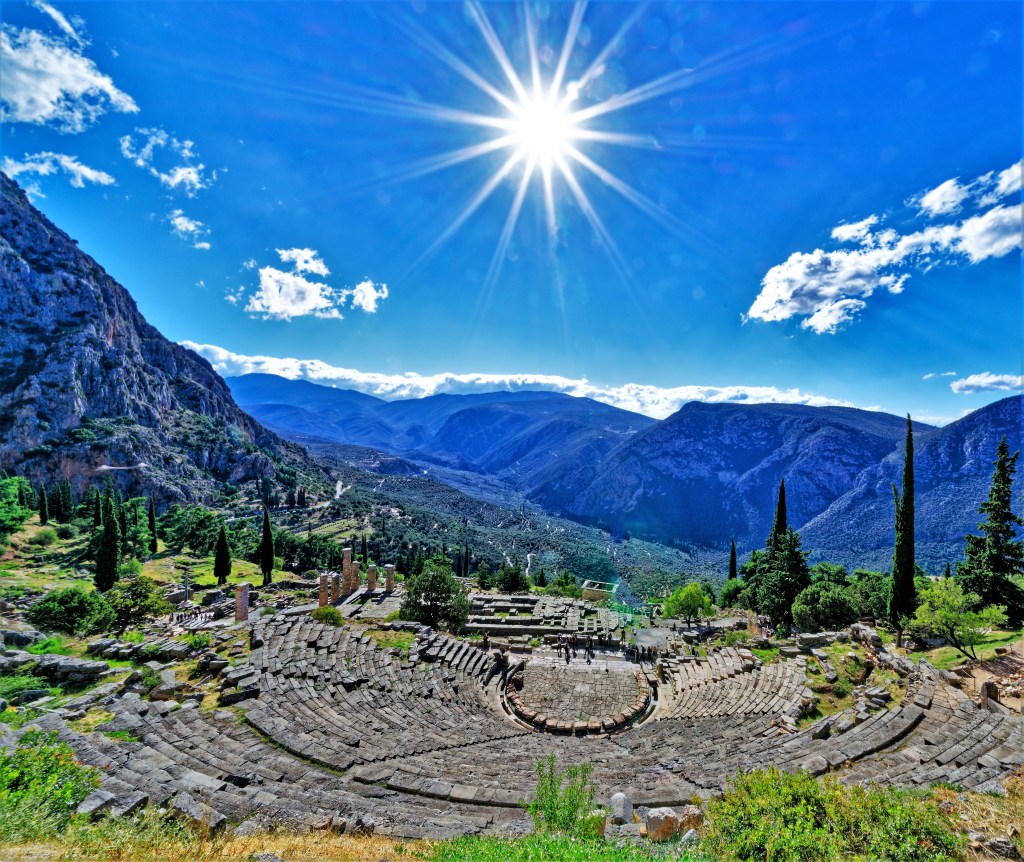
Eventually, Dionysus—the god of wine, revelry, ecstasy, and rebirth—left the temple altogether, and a gentler god would one day put on his robes.
In this older world, as winter retreated, Dionysus withdrew from Delphi; with spring, Apollo returned.
Having fasted, the Pythia bathed in the Castalian Spring and prepared to speak again for the god.
Only men, having likewise purified themselves, were permitted to approach the temple, where they offered a sacrificial goat. If the animal trembled after priests poured cold water over its back, the god was present and ready to answer.
If it did not, the question would wait.
Some men brought petty questions to the Pythia—whether wives were faithful, whether rivals plotted behind their backs.
Other men brought more profound questions, as when Chaerephon asked, “Is anyone wiser than Socrates?”
The oracle answered, “None is wiser than Socrates.”
This puzzled the philosopher. How could this be? Were not the wisest men already ruling Athens?
Certainly the polis would not entrust itself to fools.
So he set out to prove the oracle wrong. He went to the wise men of Athens and questioned them. Again and again they proved ignorant of what they claimed to know.
At last he understood: the oracle was not wrong. He was wise because he knew that he did not know. Athens’ rulers did not.
But the path to wisdom is painful. To preserve their illusions, they put the philosopher to death.
Seeking otherworldly wisdom, the ancient elite offered the oracle sacrificial goats. The Pythia’s answers shaped the fates of empires.
The Pythia and her priests were well-educated and worldly. They understood politics and power. They knew how to influence affairs while shielding themselves behind ambiguity.
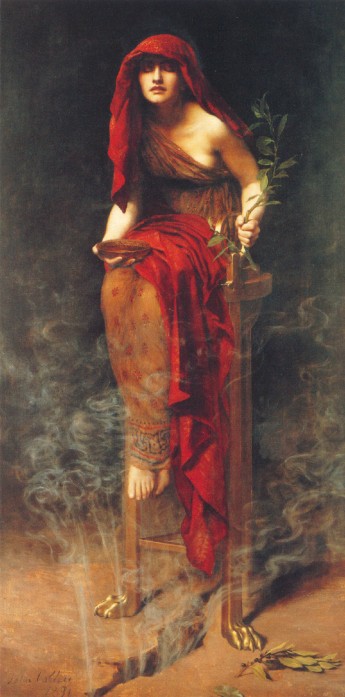
As priests read the animal’s entrails for divine signs, the Pythia entered the Adyton. There, she sat upon her tripod above the bubbling fissure and inhaled the volcanic fumes.
Falling into a trance, she spoke in tongues. Priests captured her utterances in hexametric verse. The burden of interpretation lay with the supplicant.
Many failed to read the warning inscribed at the temple’s entrance: “Know Thyself.”
A stranger to himself, Croesus—the last king of Lydia—sent golden gifts to win the oracle’s favor. When he arrived, he asked whether he should wage war against Cyrus the Great of Persia.
The oracle answered: If you wage war, a great empire will fall.
Taking this as affirmation, he marched to war. He lost his empire—and then his queen to her own hand.
He was captured, chained, and dragged before Cyrus, who had ordered a pyre prepared.
Croesus called out to Apollo, who took pity and sent rain to quench the flames.
Looking on the fallen king, Cyrus took pity and spared him.
“It is easy to obtain confirmations for nearly every theory—if we look for confirmations.”
—Karl Popper
🎧 Prefer to listen to this piece? Click here.
💉 Want to read “Veni, Vidi, Vaccine”? Click here.
 No Shortcuts to Now
Leave a comment