On The Return of The Repressed
“In some remote corner of the universe, poured out and glittering among innumerable solar systems, there once was a star on which clever animals invented knowledge.”
—Nietzsche
The life of a god is but a mythical parting of the eternal dark.
About fourteen centuries before Christ’s eastern star pierced Pagan skies, a goat fell into a chasm, and began to bleat strangely.
This perplexed its shepherd.
Having got his goat safely out, he climbed back in, and down, to inhale the vapors that bubbled up from below. He fell into a trance and began to speak in frenzied tongues.
Baffled, the shepherd ran back to his village to fetch other men. They also climbed in, and down, to inhale the earthly vapors. Likewise, they fell into trances and began to speak in frenzied tongues.
Bewildered, they needed to understand the experience. So they invented knowledge. Guided by common sense and tradition, they came to see: Gaia had possessed them.
Curiosity drew these men back to the cave again and again. Soon, several had died.
Divine possession’s not a recommended recreational activity.
So wiser authorities stepped in to regulate the matter. The sacred role of possession would belong to a woman. A priestess would speak for Gaia.
She would have to be trained to understand the divine mysteries and to approach the vapors with restraint. Before each descent, she would fast and bathe ritually.
Purified, she would speak for the Mother.
And so the oracle was born. The villagers built their first sanctuary on Mount Parnassus.
Geologists have since discovered that Mount Parnassus is laced with fault lines. Two intersect where Zeus’s eagles were said to have met—where the omphalos marked the world’s navel—where the Delphi and Kerna faults meet.
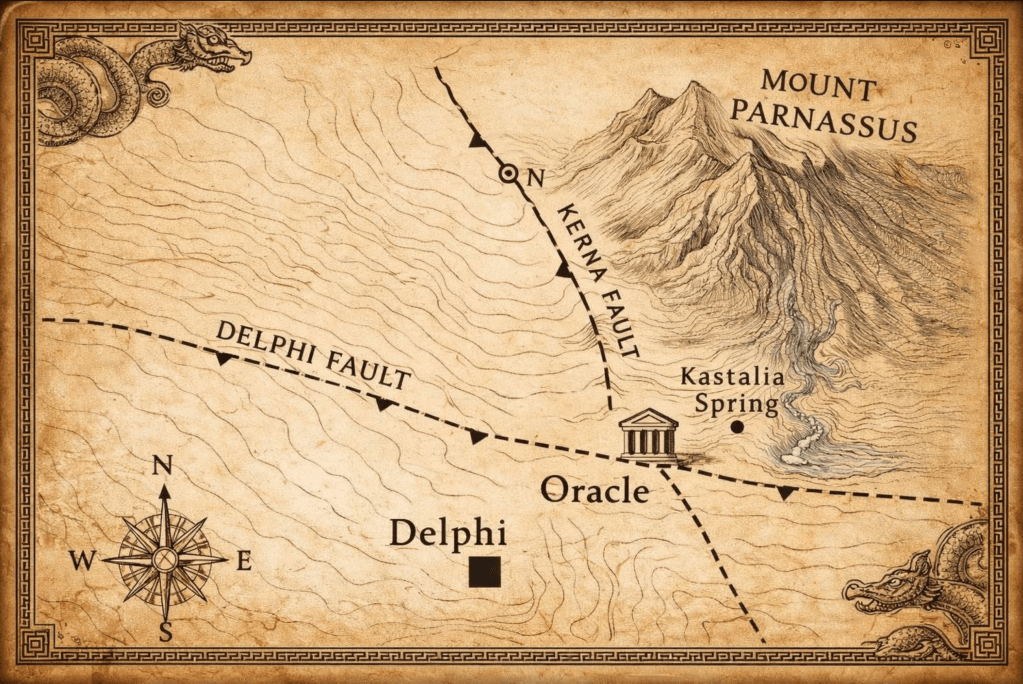
Scientists have also identified petrochemicals in the bedrock—including ethylene, a gas known to induce euphoria and trance. Water running through these fractures would have released the vapors into the cave.
It seems the earth was speaking after all.

In the eighth century BCE, one of these faults slipped. An earthquake sent rock and rubble tumbling down the mountain, burying the old sanctuary and clearing the way for a new order—the Cretan cult that would establish the Oracle at Delphi.
But the oracle’s myths, methods, and traditions had been cultivated for centuries. New religions borrow the robes of the old. The priestess remained; only the god changed.
“The most radical revolutionary will become a conservative the day after the revolution.”
—Hannah Arendt
Wearing her old robe in this new order, the priestess took the name of the slain serpent. She was now the Pythia.
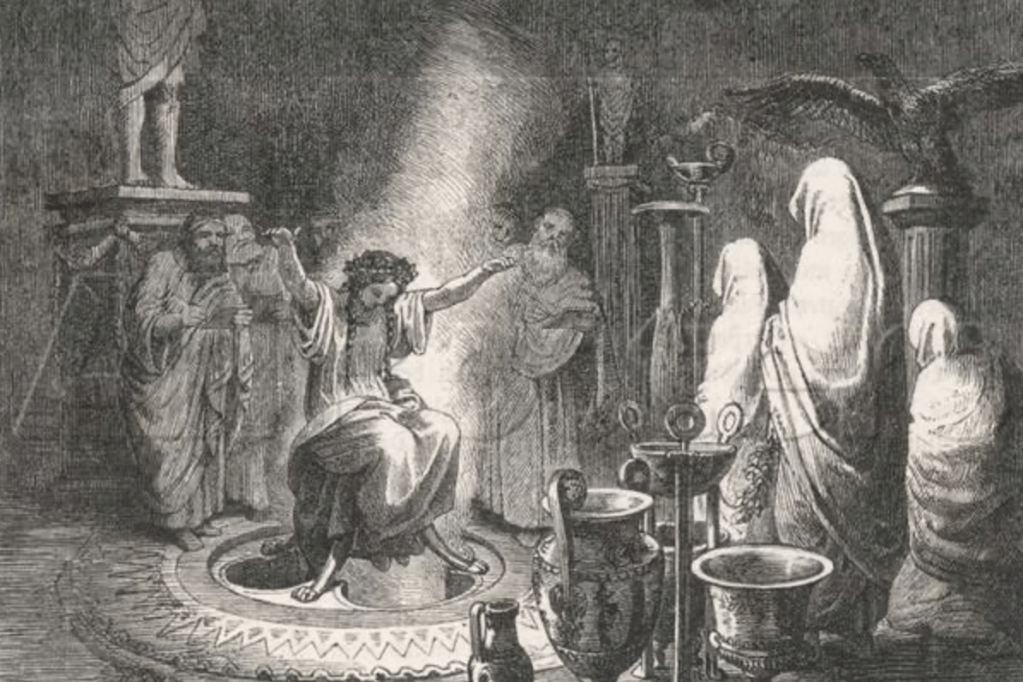
For centuries, the priestess remained a virgin—pure, young, beautiful. But then, in the third century BCE, beholding her beauty, the serpent in one man’s soul awoke: Echecrates of Thessaly forced himself upon her.
Thereafter, the Pythia would be chosen from among older women, well past the bloom of youth—that men might contemplate the waning moon.
For nine months of the year, the Pythia answered supplicants’ questions. But as the final three moons waned, Apollo departed the temple, and she retreated into her seasonal silence.
As the earth iced over, Dionysus entered the temple. Then the faithful honored the irrational heart.
🎧 Prefer to listen to this piece? Click here.
💉 Want to read “Veni, Vidi, Vaccine”? (🔒 Coming Soon)
 No Shortcuts to Now
Leave a comment