Waypoint 4.4—The Dragon Still Breathes
“The ship was named after a tribe of Massachusetts Indians, now extinct as the ancient Medes.” — Ishmael, from Moby Dick
Zeus set down the Omphalos stone by a womb-like cave, declaring it the world’s navel.1
A dragoness born of mud—a child of Gaia named Python—guarded this cave from which her mother’s oracle spoke, at Pytho.
Legend tells that the dragoness was drawn into the jealousy of Zeus’s sister-wife, Hera.
Gentle Leto carried the faithless Zeus’s twins—Artemis and Apollo—in her womb.
In her jealousy, Hera set the serpent upon the Titaness.
Driving the gentle Titaness from island to island, Python tormented her, denying her safe harbor or dry land. Leto could find no place to give birth.
At last, Zeus sent Leto the north wind to lift her from danger, and the wind, gentling, set her down upon the rocky island of Delos.
But Python persisted and was preparing to strike when Poseidon arose and crashed over the island in waves.
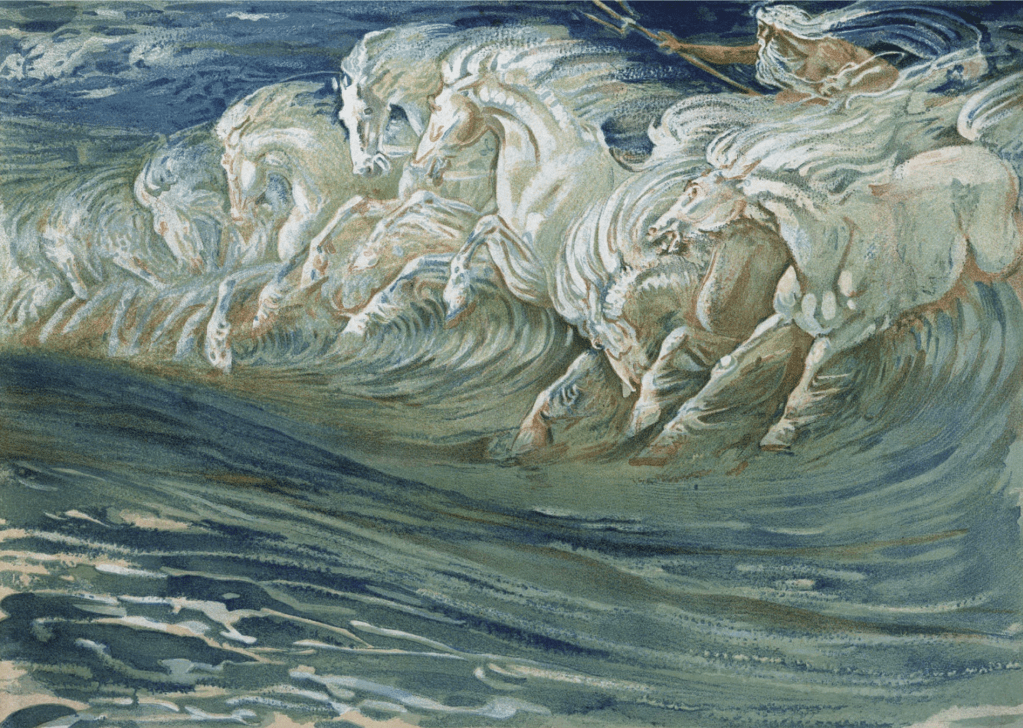
Now safe, Leto brought forth her twins: first Artemis, the goddess of the Moon, and then Apollo, the god of the Sun.
Rhea washed her grandchildren with pure water, dressed them in white, and comforted Leto until her strength returned.
Just four days old, Apollo set out to hunt his mother’s harasser. He pursued Python to the world’s navel—the cave at Pytho—where the dragoness terrorized the people.
By night, as the people slept, Python would emerge from her cave, slither through the shadows, and breathe poisonous fumes on them.
In his pursuit, Apollo met a weeping boy. He asked what troubled him, and the boy answered:
“Python came down from her cave last night and breathed her vapors on my mother. Now she sleeps and cannot wake.”
Taking pity on the boy, bright-eyed Apollo raised his golden bow and shot a shining silver arrow into the darkness of the sleeping mother’s room. The swift arrow stirred a clean wind, and the poisonous vapor rolled out, drawing in fresh air.
The mother woke and, on the instant, called to her boy, whose tears of sorrow turned now to tears of joy. He ran in to hug her. She wrapped him in her arms, kissed his brow, and held him long.
Presently, Apollo turned from the mother and her boy, selected his three straightest arrows—each crafted by Vulcan, the god of fire, forge, and volcanoes—and lifted his eye up the mountain.
He knew where the serpent slept. He climbed some two thousand feet to find her cave.
Now he approaches the cave with stealth and hides behind a boulder. He reaches into his quiver, selects his best silver arrow, strings it, takes aim, and shoots into the silent dark.
Python shrieks, screams, hisses.
All falls silent, save the dripping echoes of water.
He strings his second silver arrow and steps into the dripping dark. Strands of light dance through the shadows. He comes to perceive the walls of the cave, covered with jewels.
Now his bright eyes fall onto the coiled, writhing flesh of the dying dragoness.
Python was ready to strike. But Apollo’s silver arrow pinned her flat head to the stone floor.
She sees him, fills with fire and fury, and rips her head from the floor. Lashing out, she draws a great breath and fills the air with poisonous vapors.
Apollo lifts his golden bow and lets fly the second silver arrow, which meets its mark.
Then the fatal third.
The serpent falls dead, never to harass Leto or the people of Pytho again.
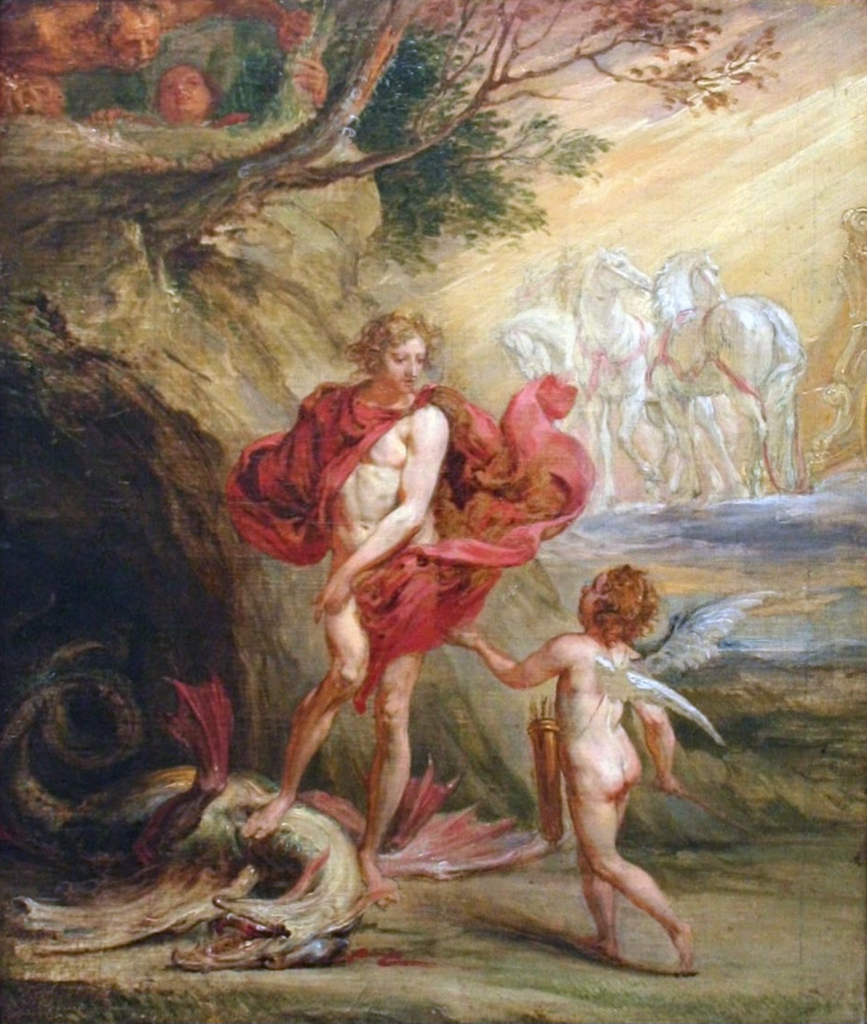
Having thus avenged his mother, Apollo buried Python under the world’s navel, directly beneath his father’s Omphalos stone.
But without a temple, the Omphalos marked only ruins. So Apollo turned to the sea, transformed himself into a great dolphin—terribly large—and dove in to search the wide watery world for measured men to build and keep his temple.
And soon enough, he found such men steering a Cretan ship.
With a quick flip of his great flukes, Apollo leapt from the sea and landed aboard. Terrified sailors scattered. Some hid below deck. Others rowed in a random, fruitless frenzy. Then they called to one another, coordinated, and tried again to steer the ship ashore.
But the ship would not obey their command.
Apollo then summoned a southern wind, which drove the ship toward Crisa, near Pytho, where they landed.
Leaping from the deck, the great dolphin vanished, and Apollo revealed to the sailors his divine form. Above their upturned eyes, the radiant god towered. Every dancing wave reflected his brilliance, and the shore was filled with light.
And now the god speaks:
You, I have chosen to be my priests, to attend my temple, where you will receive sustenance, honor, and purpose.
But you must live with measure. You must live with order, ritual, and restraint, or your honor and authority will falter.
These new priests then hiked two thousand feet up Mount Parnassus, to the Omphalos, and there built a temple without equal, whose oracle would no longer be called Pytho but Delphi, after the god’s disguise.
Deep within this temple bubbled a fissure, through which the slain dragoness’s volcanic vapors still escaped.
Above it, the priests placed a tripod. On it sat no priest, but a priestess called the Pythia, who breathed the vapors and spoke for Apollo.
🎧 Prefer to listen to this piece? Click here.
🧊 Want to read “Of ICE and Men”? Click here
 No Shortcuts to Now
Leave a comment