The Fog of ‘They’: Macbeth, Propaganda, and the Aftermath of Charlie Kirk’s Murder
“And be these juggling fiends no more believed,
That palter with us in a double sense;
That keep the word of promise to our ear,
And break it to our hope.”
—Macbeth, V.iii
In the last waypoint, The Iron Key, we reflected on time, impermanence, and the fragility of life — and on the Stoic reminder to “live immediately,” since “the whole future lies in uncertainty.”
Here, in this piece, I turn to the landscape itself, which I call “the blasted heath” in an allusion to Macbeth. In the play, the blasted heath is a battlefield. In The Iron Key, it’s the volcanic slope.
Blending these, the symbolic landscape becomes in part political, a pertinent reminder of the unstable ground on which we now find ourselves standing.
Our nation is presently in a state of shock. The bullet that ended Charlie Kirk’s life in an instant put an exclamation mark on Seneca’s reminder to “live immediately.”
Nothing is certain.
As we all watched the video of this father — as he spoke in his familiar way on the issue of gun-violence, with his wife and two little children watching in the audience — we hear the crack! of the rifle, see his head fall to the side, his body go limp, and…
In that moment, the whole nation grew pale, and our collective gorge threatened to rise.
As the young father fell, it was as if the showman — whose glib rhetoric so often courted hatred and division — dragged with him an existential curtain, ripping it open to give us all a glimpse into the universal fragility of life.
I told my own children that at school they would likely encounter the video, and that they should avoid seeing it, because they could not unsee it. My son admitted he had already watched it. He said it wasn’t as bloody as he feared. What he meant, I think, was that the horror lay elsewhere — not in the gore, but in the meaning of the loss.
What he sensed is true: the horror of the moment was not in blood, but in meaning: a young man denied his life, a wife denied her husband, two children denied their father — all in one fell swoop.
We are all living through a collective trauma — that jolt when the world proves less stable than we had trusted. The curtain tears open, a cold wind sweeps in, and we shiver.
Trauma takes many forms. Some grow numb, some lash out, some laugh, some weep — all from the same deep place. Patience serves us better than judgment. The harder reckonings can wait for gentler days.
But patience has its limits.
Not all responses are worthy of the moment.
An old high school classmate wrote to say I should “not try to be innocent,” that my “leftist Marxist messaging caused this,” and that I should be “ashamed.”
Strange.
Another told me simply that I am “a bad person.” A college friend came to my defense, and countered that I am “a good person.”
Better she keep it secret. It complicates the narrative.
For both of these childhood acquaintances, I was no longer a person, but a grammatical phantom — a ‘them,’ pasted and painted over with an insidious narrative.
Their responses were unsurprising. When the first classmate blamed my “Marxist” messaging, I replied with few words and a photo circulating of the boy in a Trump t-shirt. “Here’s your suspect,” I said.
It turns out the photo was almost certainly fake. I regret having shared it. Still, I include the detail here because it reveals something true: in the heat of outrage, any of us can reach for evidence too quickly. When I opened my private messages to find myself accused of complicity in a man’s murder, defensiveness got the better of me. I should have paused, and waited for stronger evidence to surface — as it eventually did.
Later reporting unearthed that the murderer came from a deeply conservative upbringing. His family were MAGA, steeped in gun culture, and — though this point is more speculative — his bullet casings reportedly bore slogans tied to the far-right Groyper movement: a youth subculture of trolling and white-nationalist rhetoric, already at war with Kirk for not being far enough right, not edgy enough, too mainstream — a sellout.
Whatever the truth turns out to be, it’ll likely contain facts uncomfortable to all of us, and be riddled with contradictions.
As I read the fragments now, I suspect the boy grew up within a rigid set of values, hearing again and again that the sexuality he later discovered in himself was shameful. That inner conflict must have cut deep — and Kirk, with his blend of piety, certainty, and provocation, became for him a symbol of that wound, and a target for his rage.
None of this justifies murder. Rather, it is an attempt to understand, because without understanding the complex causes, we are helpless to prevent other atrocities.
As for my old high school acquaintance, the conclusion had already been made. Before we could even discuss the evidence, he brushed it aside and shot back with borrowed language, telling me I had “TDS” — Trump Derangement Syndrome — and was nothing more than a “useful idiot.”
Seeing no hope for real conversation, I told him to enjoy his life, and blocked him. Life’s too short to reason with fence-posts.
He’ll go to his grave convinced it was the work of some Marxist-Communist-Radical-Leftist-Lunatic — one of those Who-Hates-Our-Country-ists.
But all these borrowed words and labels point to something more insidious: the way national voices reacted to the Kirk murder. Many who should have known better did worse. With vast reach and responsibility, they spoke recklessly, packaging their outrage in the third-person plural pronoun — “they.”
“When you legitimize yourself entirely by inventing enemies, the truth ceases to matter, normal restraints of civilization and decency cease to matter, the checks and balances of normal politics cease to matter.”
— Jason Stanley, How Fascism Works: The Politics of Us and Them
Jesse Watters of Fox News went on air almost immediately: “They are at war with us, whether we want to accept it or not.” Then he asked, “What are we going to do about it?”
Greg Garfield, also on Fox, said: “If they could do this, they can do anything.” Then he pivoted to the second-person plural — “you” — addressing the phantom enemy directly: “If you thought that you were going to shut a movement down, you’re going to get a rude awakening. You woke us the fuck up.”
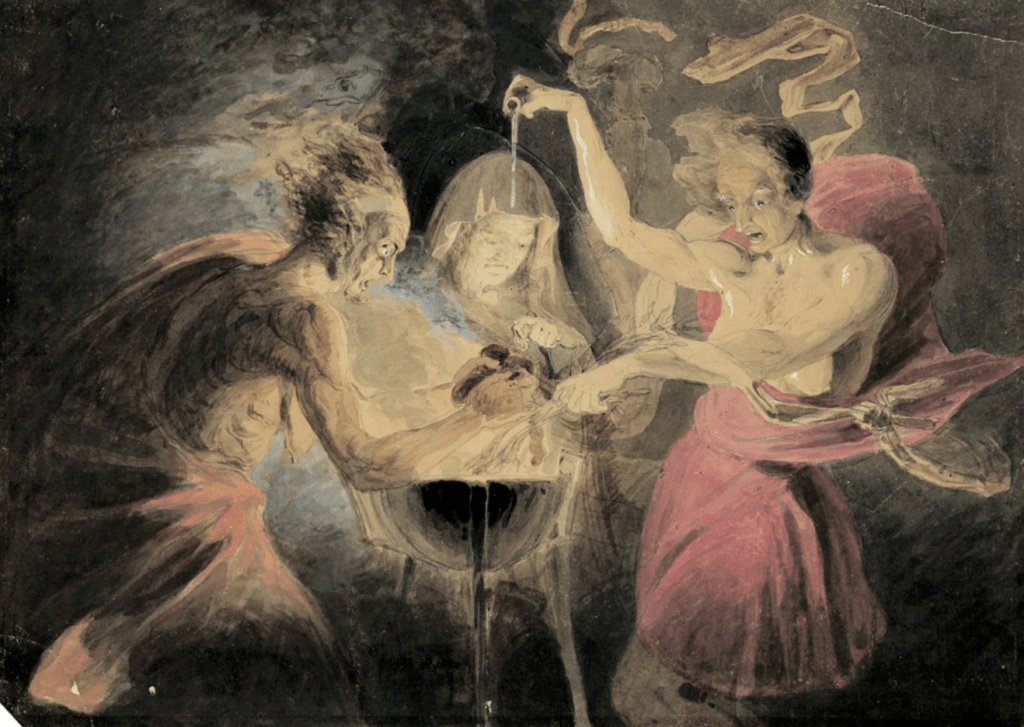
Across the blasted heath, the bizarre chorus of “they” gave way to open calls for war. And then — by the pricking of my thumbs — a video from the president this way comes, blaming “the radical left” and seeking to weaponize the tragedy.
When the boy’s father turned him in hours later, the facts began to cut through the fog and the filthy air: the murderer was no phantom “they,” but a kid bewitched by bizarre memes, deeply internalized cultural conflicts, and the dark web’s spell — double, double, toil and trouble.
And yet, even as the truth emerges, the air remains poisoned. The chorus of “they” has not fallen silent. It’s shifted, lowered with the flag to half-staff to make a martyr of a divisive man.
Still the administration seeks to pin the blame on the phantom left — thickening the filthy fog, keeping foul fair and fair foul, and the cauldron boiling.
☕ If you’d like to help keep this work going, you can buy me a coffee.
🌈 If you missed Field Note 3¾ — The Rainbow Connection: Don’t Believe Everything You Think, click here.
 No Shortcuts to Now
Leave a comment