
From Chapter 3, The Blasted Heath
“The whole future lies in uncertainty. Live immediately.”
— Seneca
On seeing so many golden torties flutter about Mt. Lassen’s moonscaped slope — all grey sand, rubble, and rock, save the occasional patch of grass or lone bloom of mountain pride, satin lupine, or Sierra lily — my son’s love for the volcanic trail rekindled. Like a flame, he lit up and took again to burning up the hill to catch our Korean friend and blaze ahead once more.
He turned a switchback and vanished from our sight.
This didn’t bother his little sister, who now had sole claim to the chocolate chip cookies in my pack. So we stopped to eat, and while her brother was gone, she devoured them all in one fell swoop. Victorious, she sipped her water. Her chin held high, she caught sight of a patch of little purple heathens growing just up the slope upon what we might call the blasted heath.
The earth hath bubbles, as the water has, and these are of them. Whither are they vanished?
— Macbeth, Act 1, Scene 3
Each little purple flower — the Purple Mountain Heather — is a real heartbreaker. Gorgeous as Venus herself, and perhaps a cause of her envy, yet this modest shrub rarely rises above a foot tall.
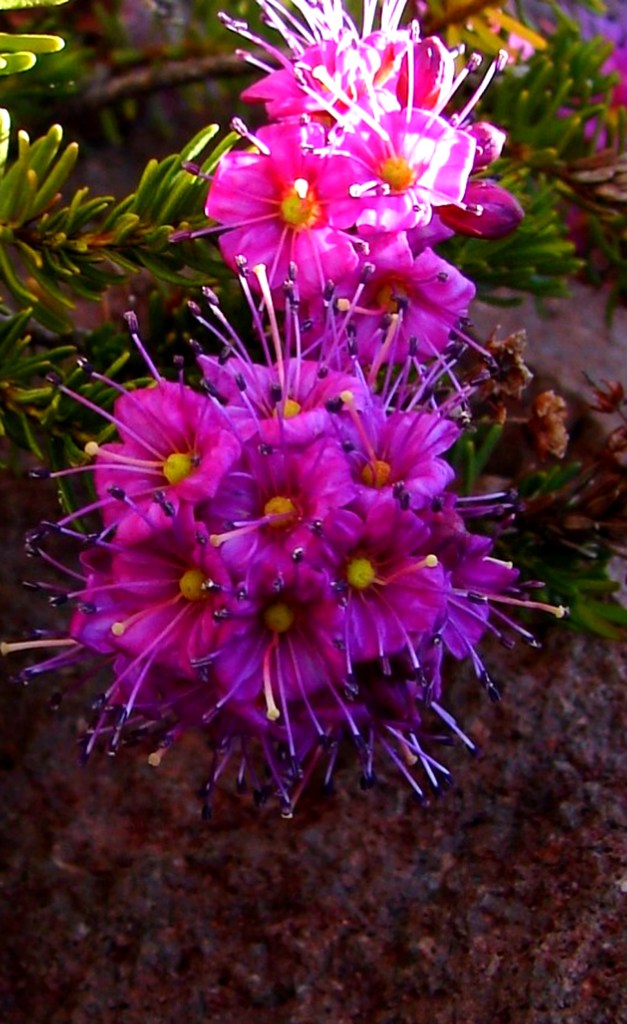
Purple Mountain Heather — gorgeous as Venus herself, and perhaps a cause of her envy.
The Purple Mountain Heather grows in abundance throughout Lassen Park — beneath the steady, jealous gaze of Vulcan’s Eye. She nestles below the rolling fumaroles, unbothered by the fog and filthy air bellowing from Bumpass Hell. She lingers in the long shadow of Brokeoff Mountain — all that remains of the once-mighty Mt. Tehama, sheared away by ancient glaciers in the hush of a forgotten ice age — or quietly sips snowmelt mist near King’s Creek Falls, though she remains no subject and serves none.
And she thrives in sunlit meadows, bending only to the breeze, tracing nearly every rocky trail, peeking from behind whichever boulder she pleases — even after the hurly-burly of the volcano’s most recent eruptions, which rumbled California from 1914 to 1917.
Even Venus’s most distant sisters and daughters must still contend with Vulcan’s jealous, heathen fire.
In May of 1915, Lassen’s Peak exploded and sent a mushroom cloud 30,000 feet into the sky — visible 150 miles to the west from Eureka, on California’s golden coast, and 190 miles to the south from Sacramento. Pacific winds carried ash 280 miles east to Elko, where, in the evening light, it seemed to fall like a strange snow — gray, and to some, tinged with a dreamlike shade of silvery-blue — light as the memory of a butterfly’s gossamer wings, and just as ghostly.
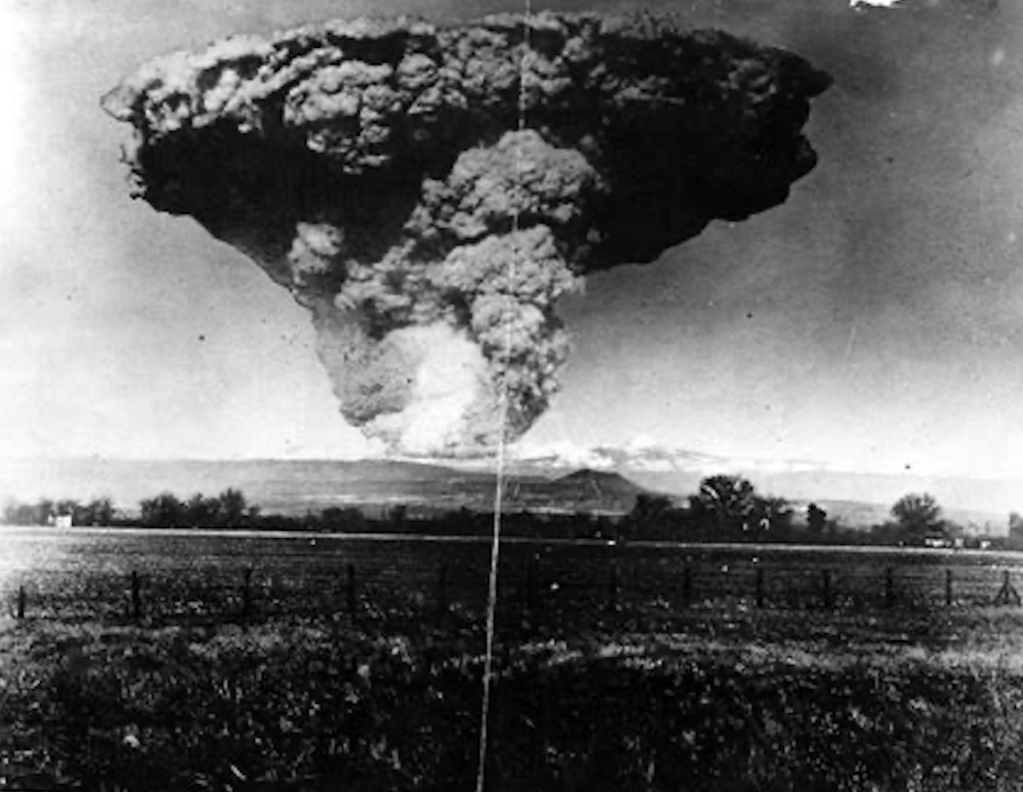
Mushroom cloud over Lassen, May 22, 1915 — photo taken from Anderson, 50 miles away. Photo by Myers & Loomis, courtesy of the National Park Service (public domain).
The feathery plume of 1915 recalls Vesuvius’s in 79 ACE. Pliny the Younger described its rising clouds not as a mushroom cloud, but as an “umbrella pine.” Yet that ashen canopy offered no shelter from the burning cinders that fell in a firestorm of sulfur and brimstone. He tells us how his father, Pliny the Elder, rushed off to view the volcano more closely — turned a switchback — and vanished from sight.
The great naturalist’s curiosity drove him
“to the place which everyone else was hastily leaving, steering his course straight to the danger zone. He was entirely fearless, describing each new movement and phase of the portent to be noted down exactly as he observed them. Ashes were already falling, hotter and thicker, as the ships drew near — followed by bits of pumice and blackened stones, charred and cracked by the flames.”1
Over him, the sky darkened to a strange and untimely night. His companions feared for their lives. They choked and struggled to breathe. Yet the Elder calmed them, and showed much courage — or pretended to show much courage, which amounts to the same.
Even so, some turned back to safety, carrying this account with them. But he did not.
Days later, when the skies had cleared and daylight returned, they found him lying fully clothed, wrapped in a cocoon of ash and dust, “looking more like sleep than death.”
Elsewhere, that same August of ’79, as it had since time immemorial in its long-evolved cycle, the Brimstone Butterfly emerged from its chrysalis. It stood reborn on some sunlit bough, stretched, and pumped its yellow-leafed wings full with life’s freshest juices.
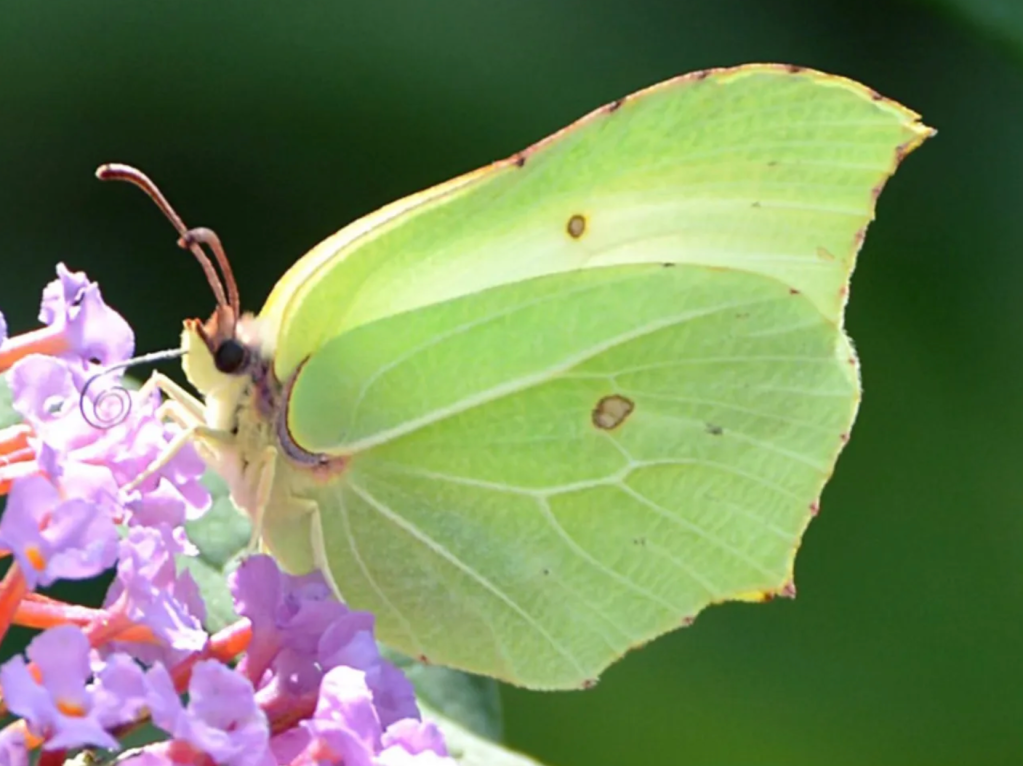
The Brimstone Butterfly — wings like pale leaves, a quiet pilgrim evolving in search of the Sacrament. Photo by Edmund Shaw via Geograph, licensed under CC BY-SA 2.0.
Every August after, without fail, the long-cast shadow of that same Brimstone has felt the lifting wind, loosened its hold on the mother-branch, and fluttered once more across the countrysides of Europe.
Year after year, it has crossed the continent — a quiet pilgrim in search of the Sacrament — from southern Italy to northern Ypres, where its descendants still sip from late-summer blossoms through September, as if untouched by the battles that once raged there, filling it with flowing life until the time comes again to sleep the long winter through — until that day returns,
Whan that Aprille with his shoures soote,
The droghte of March hath perced to the roote,
And bathed every veyne in swich licóur
Of which vertú engendred is the flour.
— Chaucer, Canterbury Tales, “The General Prologue”
The same eruption that took Pliny the Elder’s life buried Pompeii beneath its cinders — and tucked its people in for the long winter’s sleep.
They had been going about their daily lives, making plans for a tomorrow that never came. One of them — like a walking shadow — still holds up his brief candle to light the graffiti he left behind, as if to mock us:
Out, out —
Gaius was here.
One man, waxing romantic under a Mediterranean moon, proclaimed with Vulcan-like pride:
Anyone who does not believe in Venus should look upon my girlfriend.
Shall we compare her to that rumbling summer’s day? So long as men can breathe, and Vulcan’s Eye can see…
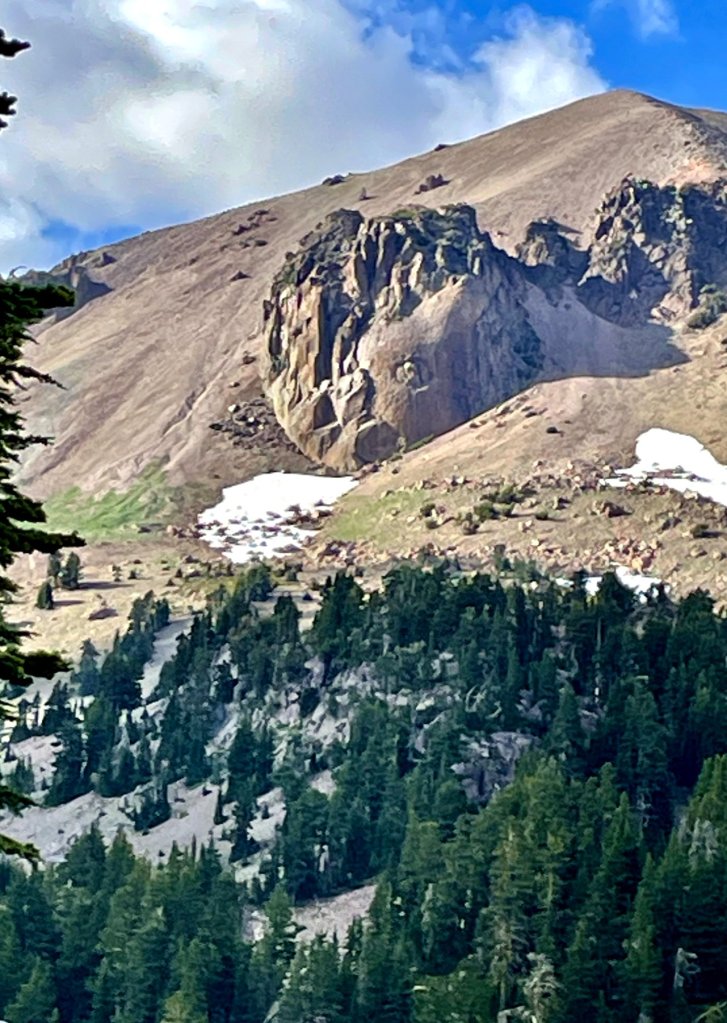
The jealous gaze of Vulcan’s Eye, watching over Lassen’s southern slope. Photo by author.
Another eternal line — less lovely, less temperate — was carved into the wall of a brothel. It cut to the unchaste chase, and erupted in one man’s unequivocal pride:
Posphorus fucked here.
That rented night under our ancient moon turned out to be more than one small step for a man — but one giant leap for profanity.
Yet all this leaves us to wonder: what strange digital pearls will we leave in the ash for posterity?
Ultimately, even these shadows will fall silent beneath the swirling, pixelated stars — for the totality of written human history is but a moment between ice ages.
Pompeii’s archaeologists also found rooms full of skeletons. One woman lay face-down, arms flung wide — an iron key clasped in one hand, a bag of coins in the other. She was prepared, it seems, to pay Charon, the ferryman of the River Styx.
She died in a flight of terror. Her mouth remains open, caught mid-scream — a cry primeval, echoing strangely the immense silence between the stars.
Among the ashes of Herculaneum, archaeologists found one peculiar black glass object: once, a human brain.
Curious scientists put their living heads together and deduced: to vitrify grey matter, the ground temperature must have surged to at least 750°F — that’s 129 degrees hotter than it takes to melt lead, and nearly as hot as the surface of sweet Venus, scorched by her own runaway greenhouse effect.
Therefore, ‘tis certain: the green eye of Vulcan.
These modern naturalists figured further that her death must have been swift — painless, even — though they have no first-hand report. Only mute samples. Data. Induction.
The dead keep their secrets locked in a little black box — a gift from Venus, perhaps, filled with fatal beauty, polished to obsidian, sealed with a long-lost iron key.
📖 Prefer to read it on Substack?
✉️ Subscribe on Substack to follow the journey as it unfolds.
🌈 Miss Field Note 3 3/4: The Rainbow Connection: Don’t Believe Everything You Think? Click here.
The ferryman asked for coins. I beg for beans.
 No Shortcuts to Now
Leave a comment