Or: Don’t You Be My Neighbor
“All cruelty springs from weakness.”
— Seneca
“It’s much easier to erode a child’s self-esteem than to build it up.”
— Mister Rogers
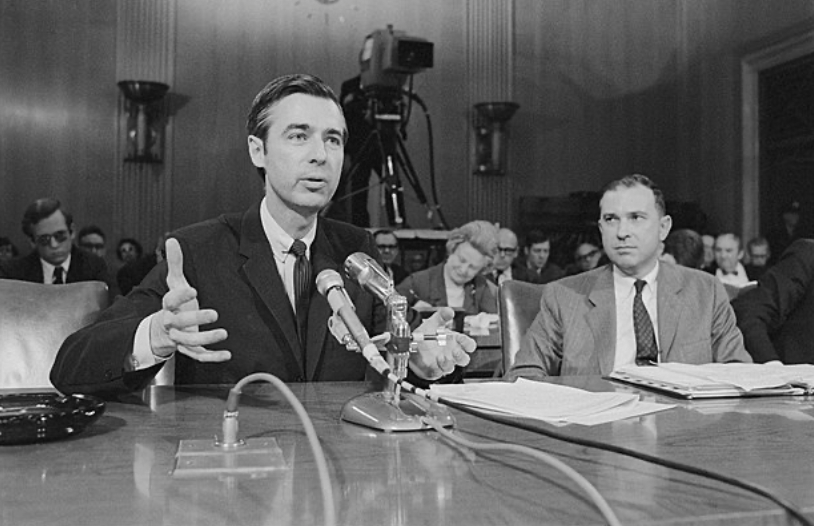
Fred Rogers defends public broadcasting before the U.S. Senate, May 1, 1969. In his quiet voice, he made the case for nurturing children’s emotional well-being through television: “I give an expression of care each day to each child, to help him realize that he is unique.” [Photo: Library of Congress]
When I wrote Waypoint 1.1, “Vulcan’s Evangelist,” I conjured a playful scene in which my son, like an incipient pagan god, repeatedly buried Sesame Street in volcanic ash. At the time, it was mythic metaphor — a child’s game laced with irony. Now, it reads more like foreshadowing:
The people of Pompeii knew no disaster like that which buried Sesame Street that night. How many pyroclastic flows slipped down that mountainside, I can’t recall. Count von Count counted a fifth, a sixth, a seventh, and a twentieth fire-show. With each new ashen security-blanketing of Bert and Ernie, I began to better resemble Oscar the Grouch.
Soon, my third empty beer bottle began to tremble and shake, and I belched. Yet my son’s little seismograph detected not the slightest tremor, as the twenty-first burst began from above.
“Vah-ca-no! Boom! Pwikhhh! Big Bird bye-bye!”
Of course, the scene was meant to be playful, a glimpse of the world through a child’s eyes. But I meant to do more than juxtapose the innocence of a powerless child with the absolute power of indifferent nature.
I meant also to introduce certain themes about the authoritarian playbook — and the silencing of dissent.
In Waypoint 1.3, “The Trailhead,” I return to this undercurrent, as we prepare to hike Lassen:
We arrived at the trailhead mid-morning. I clicked off the radio — yes, it was NPR, back before its funding landed on the chopping block — and tried to tune out the early rumblings of Trump’s first impeachment.
The scene quickly grows mythic, as my children transform into trickster figures resembling Ratatoskr — the squirrel from Norse myth who stirs conflict between the eagle above and the dragon below, running up and down the World Tree as a kind of mythic pundit.
When writing those scenes, I had in mind the authoritarian’s desire to disinform and suppress. I had already noted the tendency in our own political landscape to draw from that same playbook. I had seen it before.
You see, I was in Russia the night Putin took power. It was New Year’s Eve, 1999, when Yeltsin resigned and appointed the former KGB agent as Acting President of the Russian Federation. Putin’s campaign against the free press began almost immediately. He used economic pressure to seize control of NTV, Russia’s most influential independent TV station. Then he took over ORT and RTR, turning them into propaganda outlets. Editorial independence evaporated.
He used tax audits and regulatory fines to discipline journalists. He smeared those who disagreed with him, labeling them “foreign agents” and “enemies of the state.” Some were murdered for investigating corruption — including Anna Politkovskaya and Natalya Estemirova. Under a slow, ashen security blanketing, Russian journalism suffocated.
By the 2010s, his regime passed laws branding independent outlets and NGOs as “foreign agents,” tightened censorship, and gained the power to block websites at will. Today, nearly all Russian media is state-controlled. Independent newspapers have been exiled. Russia now ranks among the worst countries in the world for press freedom.
Trump does not like being outdone.
Of course, when I was in Russia, I was still quite young and much more naive. I was busy learning how to make toasts and how to pack my belly with potatoes so my drinking buddy across the table wouldn’t outdrink me.
Older now — and a better advocate for my liver and my children’s future — I see more clearly what Russia has become under its fascist government. I see how the Kremlin controls the minds of its people. So when I awoke this morning to more news of media suppression, I was at least thankful I still got that news — and that it hadn’t yet been dressed up for the greater glory of the state and our dear leader.
No one was dismembered for reporting this story — unlike Jamal Khashoggi, the Washington Post columnist who was murdered and dismembered inside a Saudi consulate. Trump dismissed the killing, saying Khashoggi “wasn’t really a citizen” and besides, “wasn’t a fan” of his. But Khashoggi’s true offense was investigating the crown prince’s crackdown on dissent — and advocating for a freer press in the Arab world.
But what has all this to do with Big Bird’s bye-bye?
In short, it’s straight out of old Putin’s playbook. On May 1, 2025, Trump issued Executive Order 14290 — “Ending Taxpayer Subsidization of Biased Media” — directing the Corporation for Public Broadcasting (CPB) and related agencies to “cease all funding for NPR and PBS.”
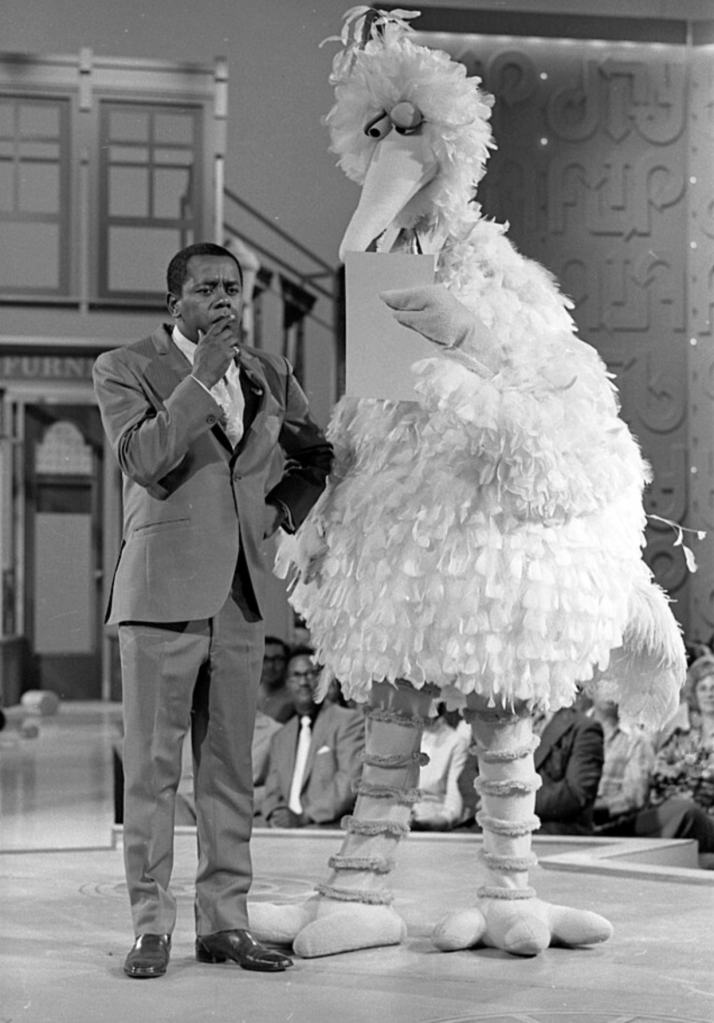
Big Bird meets Flip Wilson, 1970. When Sesame Street’s iconic character appeared on The Flip Wilson Show — the first prime-time variety show hosted by a Black entertainer — it wasn’t just a media crossover. It was a cultural statement: children’s public media standing arm-in-arm with Black-led entertainment, reaching across lines of race, class, and age. Defunding that legacy today doesn’t just erase programming — it erases progress. Photo by Larry Bessel, Los Angeles Times. Courtesy UCLA Library. CC BY 4.0.
The order laid the groundwork for Congress’s $1.1 billion rescission of public media funding on July 18 — and for burying Big Bird, Sesame Street, and other so-called “woke” programs. For generations, Sesame Street has offered free, research-based early education to children often left behind by systemic inequality — making its defunding not only racially and economically punitive, but also a calculated swipe at the liberal values of inclusion, public service, and educational equity.
Just weeks earlier, on July 2, CBS’s parent company, Paramount Global, quietly settled a defamation suit with Trump for $16 million — despite no finding of wrongdoing. The dispute centered on a 60 Minutes interview with Kamala Harris, in which CBS followed standard editorial practice.
Rather than challenge the claim in court, Paramount caved — fearing that a legal fight might jeopardize FCC approval for its pending merger. They feared for their profits, not for the truth — and certainly not for the future of our children or a free press.
Days later, CBS announced the cancellation of The Late Show with Stephen Colbert, its highest-rated late-night program, and one of the few major platforms consistently critical of Trump. One of Putin’s first pivotal moves was to shut the comedians up.
Senator Warren called it what it looked like: a payoff.
In Waypoint 1.1, I dubbed the occupant of the Oval Office the “Coup Clux Clown.” But this is a slow coup — and there’s little here to laugh at.
📌 Related Waypoints:
- 🌋 Waypoint 1.1: “Vulcan’s Evangelist” — Big Bird’s first burial
- 🌋 Waypoint 1.3: “The Trailhead” — NPR, impeachment, and early seismic signals
Want to follow the journey as it unfolds on Substack? 📘 Begin here
This project runs on thought, time — and a little coffee. Support it below!
 No Shortcuts to Now
Leave a comment